Red Light Therapy for Acne and Acne Scars

Red Light & Acne: Human Studies, Best Wavelengths, Results, and What the Research Really Shows
Red light therapy is increasingly popular for acne, acne-prone skin, redness, and post-breakout recovery.
But the research is more nuanced than many marketing claims suggest.
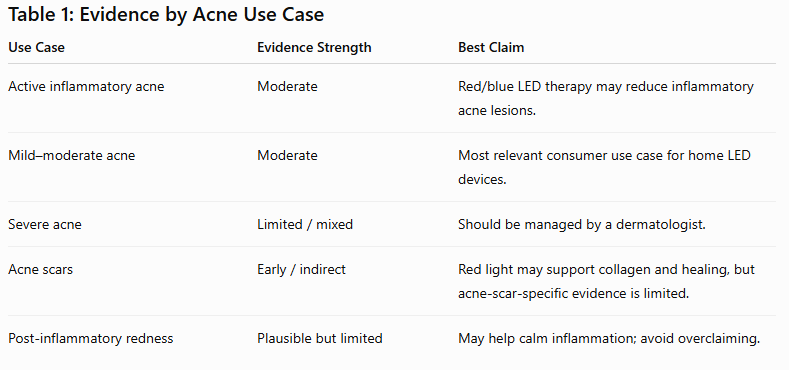
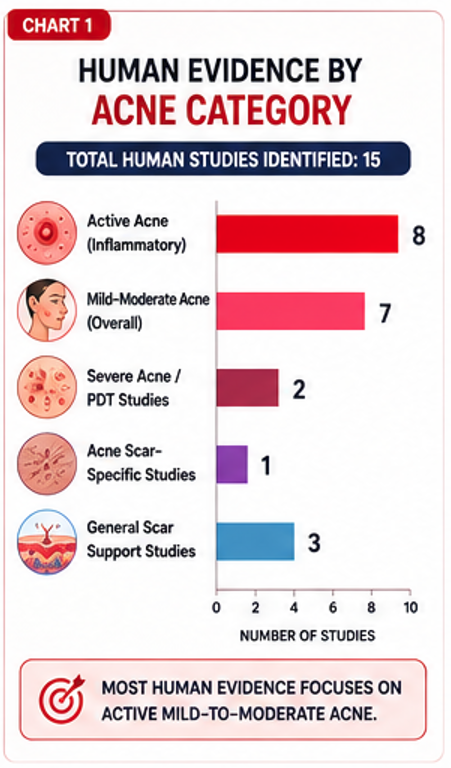
Human studies show the strongest support for mild-to-moderate inflammatory acne, especially when red light is combined with blue light. Evidence for acne scar reduction is much weaker and more indirect, relying mostly on collagen, wound-healing, and general scar photobiomodulation research rather than acne-scar-specific trials.
Key Takeaways
Blue + red LED therapy has human evidence for mild-to-moderate acne.
Red light alone has shown benefit in some human acne studies.
Red light may help calm inflammation and support healing.
Acne scar reduction evidence is promising but indirect.
Severe, cystic, painful, or scarring acne should be managed by a dermatologist.
At-home light therapy works best as a consistent skincare support tool, not a miracle cure.
A red light therapy panel may support broader skin health, but acne-specific devices often combine blue and red wavelengths.
What Causes Acne?
Acne develops when pores become blocked with oil, dead skin cells, bacteria, and inflammation.
Common contributors include:
excess sebum
clogged follicles
Cutibacterium acnes activity
inflammation
hormonal changes
genetics
skincare products
stress and lifestyle factors
Because acne is inflammatory, light therapies are often studied for their ability to reduce visible redness, inflammatory lesions, and bacteria-related pathways.
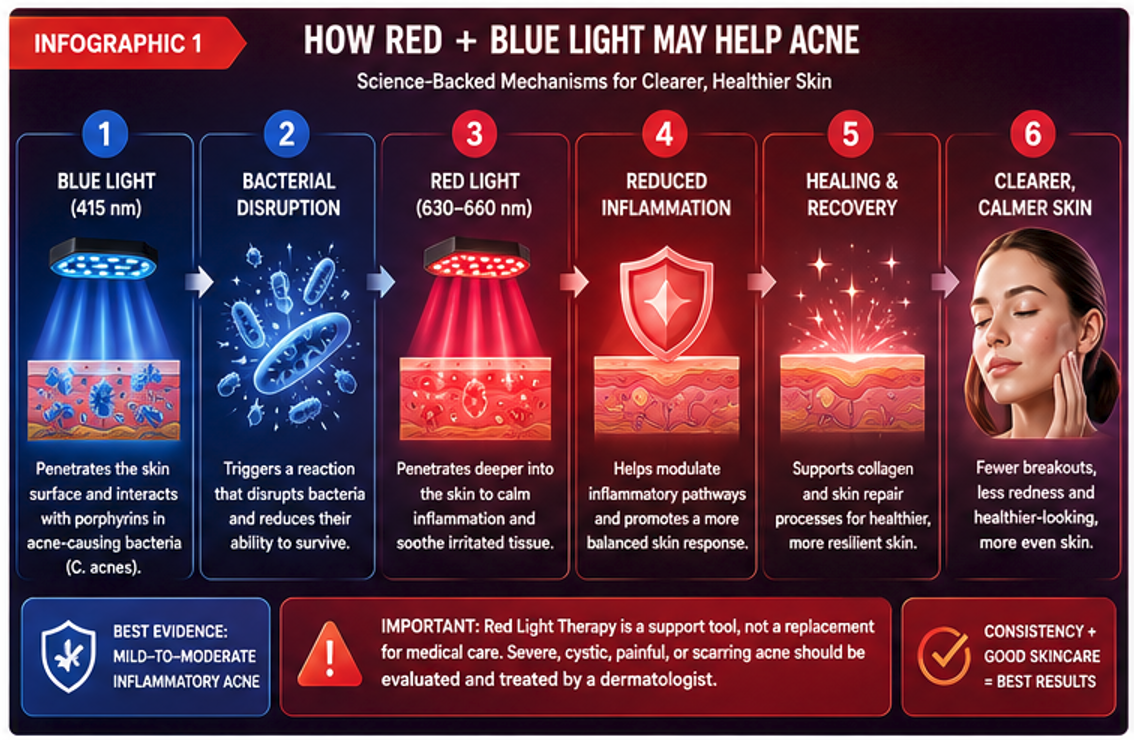
How Red and Blue Light May Help Acne
Blue light and red light affect acne differently.
Blue light is commonly used because it interacts with porphyrins produced by acne-associated bacteria.
Red light is studied for its anti-inflammatory and healing-support effects.
Together, blue and red light may address two important acne pathways:
Bacteria-related activity
Inflammatory response
A review of light-based acne therapies found that blue light and blue-red light combinations appear useful for mild-to-moderate inflammatory acne, though better long-term trials are still needed.
Human Studies on Red Light Therapy for Acne
One of the earliest randomized studies included 107 patients with mild-to-moderate acne and compared blue light, mixed blue/red light, cool white light, and benzoyl peroxide. The mixed blue/red group showed meaningful improvement in acne lesions.
Goldberg and Russell later reported that combination blue 415 nm and red 633 nm LED therapy had strong potential for mild-to-severe acne and appeared well tolerated.
A randomized single-blinded clinical trial by Na et al. reported that red light phototherapy alone may be a therapeutic option for acne vulgaris.
Kwon et al. conducted a double-blind randomized controlled trial using a home-use blue/red LED device and reported reductions in inflammatory and non-inflammatory lesions, along with histological changes such as reduced inflammatory cell infiltration and sebaceous gland size.
More recently, Li et al. found that red light and blue light had similar efficacy for mild-to-moderate acne, especially inflammatory lesions, with red light showing fewer adverse reactions.
Chart 1: Human Evidence by Acne Category
Best Wavelengths for Acne
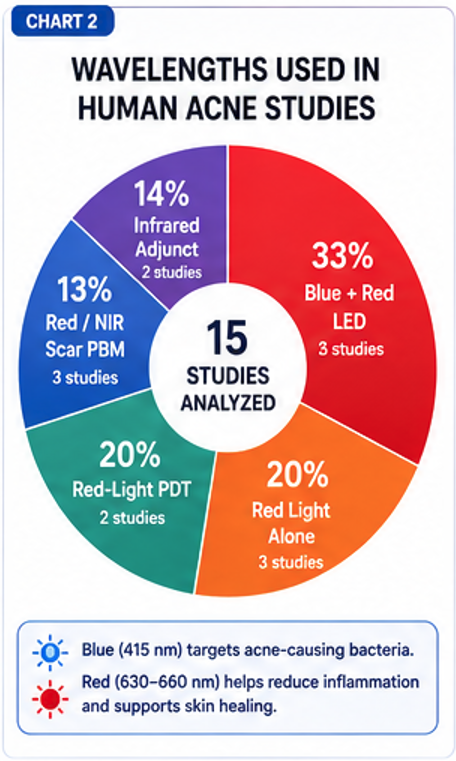
The most common acne light therapy wavelengths include:
415 nm blue light
633 nm red light
660 nm red light
630 nm red-spectrum laser
830 nm near-infrared as an adjunct
Table 2: Wavelengths Used in Human Acne Studies
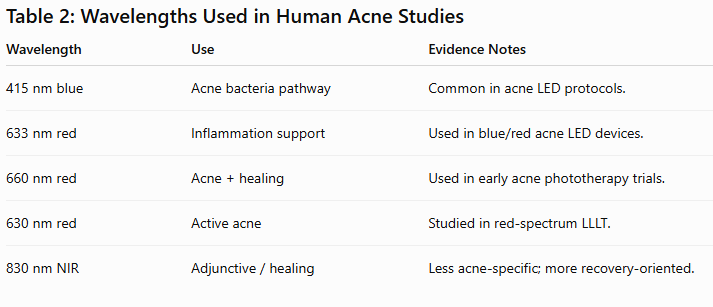
Chart 2: Wavelength Frequency
Does Red Light Therapy Help Acne Scars?
This is where the evidence becomes more cautious.
Red light therapy is often marketed for acne scars because it may support collagen, healing, and inflammation pathways. However, direct human studies specifically proving red light therapy reduces established acne scars are limited.
A broader LLLT dermatology review notes potential benefits for acne scars and hypertrophic scars, but this is not the same as strong acne-scar-specific clinical evidence.
Other scar studies suggest red or near-infrared photobiomodulation may help scar appearance, pigmentation, thickness, or patient satisfaction, but many of these studies involve post-surgical, burn, or hypertrophic scars rather than acne scars.
Honest Evidence-Based Claim
Red light therapy may support skin healing and collagen-related repair after acne, but current evidence is stronger for active acne reduction than for established acne scar remodeling.
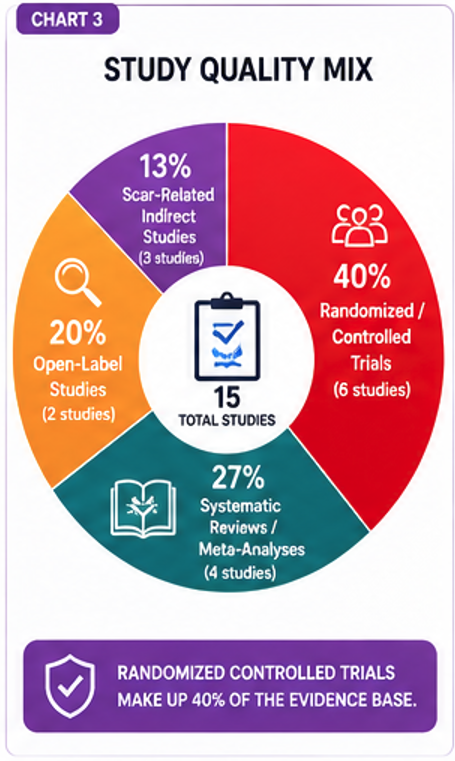
Chart 3: Study Quality Mix
What Outcomes Improve Most Often?
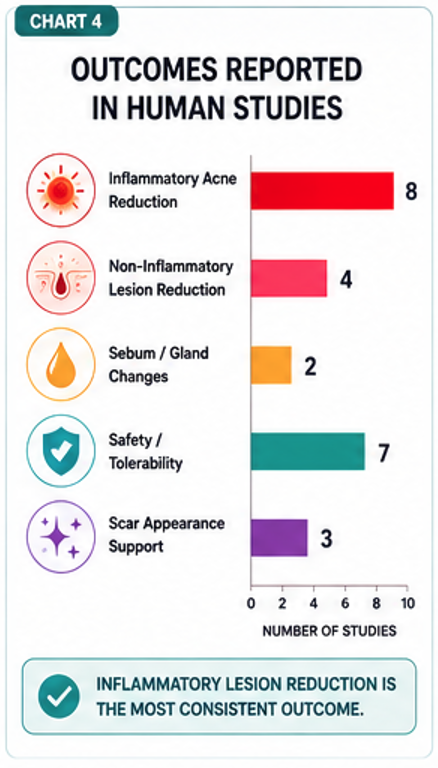
Human acne light therapy studies commonly measure:
inflammatory lesion reduction
non-inflammatory lesion reduction
sebum or gland changes
safety and tolerability
redness and inflammation
patient satisfaction
Chart 4: Outcomes Reported
How Long Does Red Light Therapy Take for Acne?
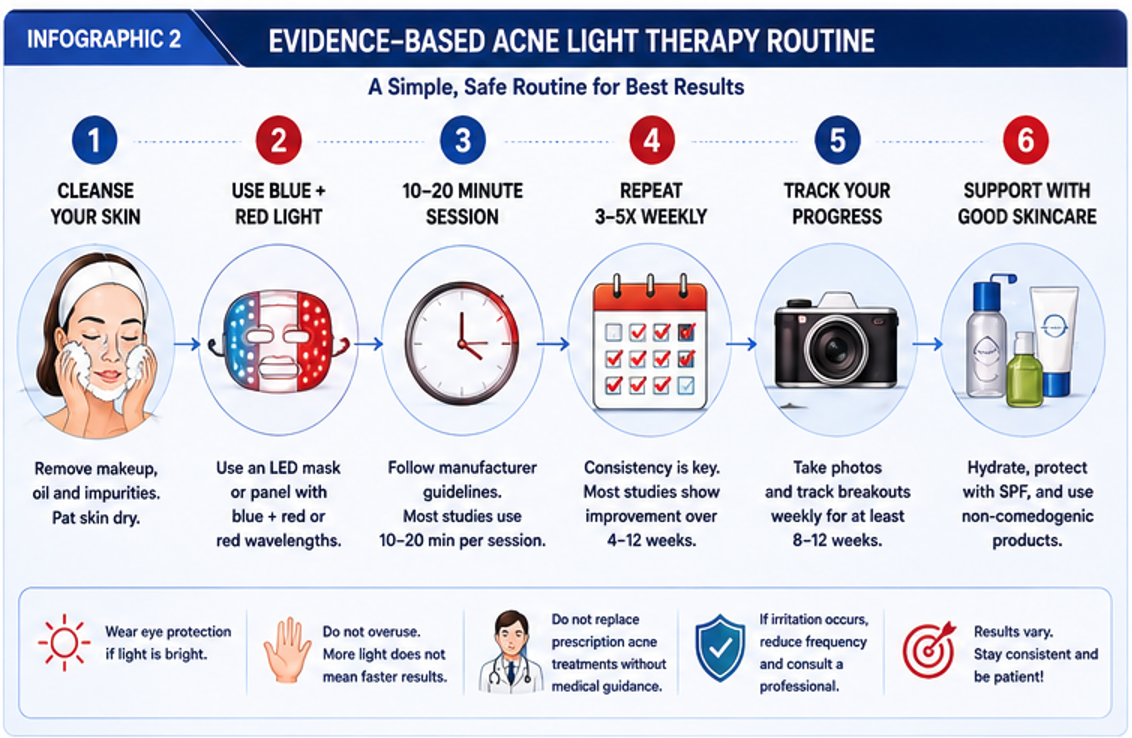
Most studies use repeated sessions over several weeks.
Typical protocols include:
multiple treatments weekly
4–12 week study periods
consistent home or clinic use
follow-up after treatment
A practical consumer expectation is to track results for at least 8–12 weeks.
Infographic 2: Evidence-Based Acne Light Routine
Red Light Panel vs Acne LED Mask
Table 3: Red Light Panels vs Acne LED Masks
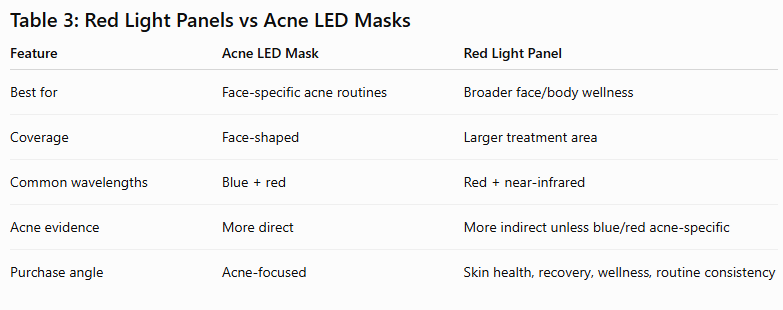
Acne LED masks often include blue + red wavelengths, making them more acne-specific.
Red light panels are often more versatile for:
broader skin wellness
facial redness
post-breakout recovery support
body acne support
muscle recovery
full-body wellness routines
For customers who want one device for both skin and wellness, a red light therapy panel can be valuable—but it should not be marketed as a standalone acne cure.
Chart 5: Best-Supported Consumer Claims
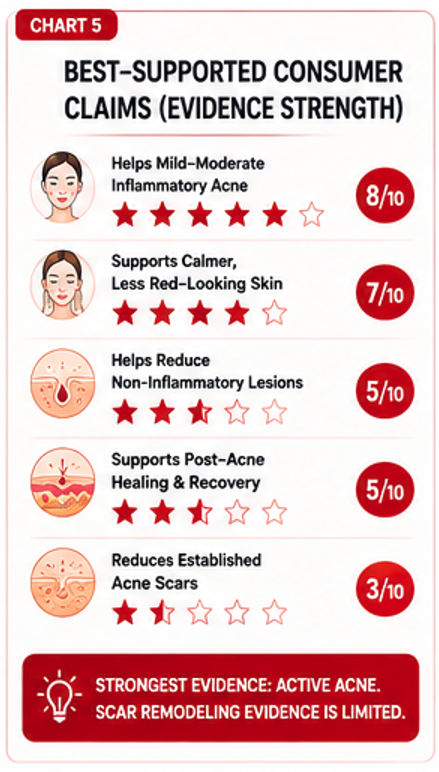
Strongest claim: Red/blue light may support mild-to-moderate inflammatory acne.
Weakest claim: Red light alone definitively removes established acne scars.
Safety: Who Should Be Careful?
Light therapy is generally well tolerated in many studies, but users should be cautious if they:
have severe acne
have cystic or painful acne
are developing scars
use photosensitizing medications
have melasma or hyperpigmentation risk
have a history of light sensitivity
are under dermatologic treatment
have eye sensitivity
Always follow manufacturer instructions and use eye protection when recommended.
How to Choose the Best Red Light Therapy Device for Acne-Prone Skin
Look for:
1. Evidence-Aligned Wavelengths
For acne, blue + red is the most evidence-aligned combination.
2. Transparent Specs
Choose brands that disclose wavelength, usage guidance, treatment time, and safety instructions.
3. Comfortable Routine
Consistency matters. The best device is one users will actually use.
4. Skin-Safe Design
Avoid harsh heat, excessive exposure, and unclear dosing.
5. Realistic Claims
Trustworthy brands should not promise to cure acne or erase scars overnight.
Recommended Product Positioning
If your brand sells red light panels, position them as:
skin wellness tools
inflammation-support tools
post-breakout recovery support
full-body red light therapy devices
complementary devices for consistent routines
Avoid claiming that a panel cures acne, replaces dermatologist care, or removes acne scars.
Ready to Upgrade Your Skin Routine?
A high-quality red light therapy panel can help support your daily skincare and wellness routine with clinically relevant red and near-infrared wavelengths.
Use it for:
skin wellness
post-breakout recovery support
redness-prone skin routines
full-face and body coverage
muscle recovery and wellness
Shop Red Light Therapy Panels
FAQ
Does red light therapy help acne?
Human studies suggest red light and especially blue + red LED therapy may help mild-to-moderate inflammatory acne.
Is blue light or red light better for acne?
Blue light targets acne-related bacterial pathways, while red light supports inflammation and healing pathways. Many studies use both.
Does red light therapy remove acne scars?
Evidence is limited. Red light may support collagen and healing, but strong acne-scar-specific proof is lacking.
How long does red light therapy take for acne?
Many routines require several weeks of consistent use. Track progress over 8–12 weeks.
Can I use red light therapy with acne medication?
Ask your dermatologist, especially if you use photosensitizing medications or prescription acne treatments.
For Additional Reading:
Check out our most popular blogs on red light therapy to save you time and money on your next purchase with Medford Red Light Therapy:
Scientific References
Papageorgiou P, Katsambas A, Chu A. Phototherapy with blue 415 nm and red 660 nm light in the treatment of acne vulgaris. British Journal of Dermatology. 2000.
Goldberg DJ, Russell BA. Combination blue 415 nm and red 633 nm LED phototherapy in the treatment of mild to severe acne. 2006.
Na JI, et al. Red light phototherapy alone is effective for acne vulgaris. 2007.
Lee SY, et al. Blue and red light combination LED phototherapy for acne vulgaris. 2007.
Aziz-Jalali MH, et al. Comparison of red and infrared low-level laser therapy in the treatment of acne vulgaris. 2012.
Kwon HH, et al. Clinical and histological effect of home-use combination blue-red LED phototherapy for mild-to-moderate acne vulgaris. 2013.
Avci P, et al. Low-level laser light therapy in skin. 2013.
Pei S, et al. Light-based therapies in acne treatment. 2015.
Barbaric J, et al. Light therapies for acne. Cochrane Review. 2016.
Li J, et al. Comparison of red light and blue light therapies for mild-to-moderate acne vulgaris. 2022.
Wu Y, et al. Application of red light therapy for moderate-to-severe acne vulgaris: systematic review and meta-analysis. 2021.
Kurtti A, et al. Light emitting diode-red light for reduction of post-surgical scarring. 2021.
Shurrab K, et al. Photobiomodulation therapy for enhanced wound and scar healing. 2025.
Ablon G. Combination blue 415 nm and red 633 nm LED home therapy for mild-to-moderate acne. 2025.
Gaumond SI, et al. Red and near-infrared photobiomodulation for burn, hypertrophic, and post-surgical scars. 2026.
Park KY, Han TY, Kim IS, et al. The effects of 830 nm light-emitting diode therapy on acute herpes zoster ophthalmicus: a pilot study. Ann Dermatol. 2013;25:163-167.
Phung V-D, Jung W-S, Nguyen T-A, et al. Reliable and quantitative SERS detection of dopamine levels in human blood plasma using a plasmonic Au/Ag nanocluster substrate. Nanoscale. 2018;10:22493-22503.
Avci P, Gupta A, Sadasivam M, et al. Low-Level Laser (Light) Therapy (LLLT) in Skin: Stimulating, Healing, Restoring. In: Seminars in Cutaneous Medicine and Surgery. NIH Public Access; 2013:41.
Jagdeo J, Austin E, Mamalis A, et al. Light-emitting diodes in dermatology: a systematic review of randomized controlled trials. Lasers Surg Med. 2018;50:613-628.
de Freitas LF, Hamblin MR. Proposed mechanisms of photobiomodulation or low-level light therapy. IEEE J Sel Top Quantum Electron. 2016;22:348-364.
Kook JK, Phung V-D, Koh D-Y, Lee S-W. Facile synthesis of boronic acid-functionalized magnetic nanoparticles for efficient dopamine extraction. Nano Converg. 2019;6:30.
Mansoori B, Mohammadi A, Doustvandi MA, et al. Photodynamic therapy for cancer: role of natural products. Photodiagnosis Photodyn Ther. 2019;26:395-404.
Agostinis P, Berg K, Cengel KA, et al. Photodynamic therapy of cancer: an update. CA Cancer J Clin. 2011;61:250-281.
Conrado PCV, Sakita KM, Arita GS, et al. A systematic review of photodynamic therapy as an antiviral treatment: potential guidance for dealing with SARS-CoV-2. Photodiagnosis Photodyn Ther. 2021;34:102221.
Elman M, Lebzelter J. Light therapy in the treatment of acne vulgaris. Dermatol Surg. 2004;30:139-146.
Rai R, Natarajan K. Laser and light based treatments of acne. Indian J Dermatol Venereol Leprol. 2013;79:300.
Geisler A, Siegel DM. Commentary on light emitting diode-based photodynamic therapy for photoaging, scars, and dyspigmentation. Dermatol Surg. 2020;46:1395-1396.
Lian C, Piksa M, Yoshida K, et al. Flexible organic light-emitting diodes for antimicrobial photodynamic therapy. npj Flex Electron. 2019;3:1-6.
Kalajian TA, Aldoukhi A, Veronikis AJ, et al. Ultraviolet b light emitting diodes (leds) are more efficient and effective in producing vitamin D 3 in human skin compared to natural sunlight. Sci Rep. 2017;7:1-8.
Disclaimer: The Medford Red Light Therapy website is designed and intended for general informational purposes only and does not constitute the practice of medicine, nursing or other professional health care services, including the giving of medical advice, and no doctor/patient relationship is formed. The use of information on this website is at the user’s own risk. Results may vary by individual. The content of this website is not intended to be a substitute for professional medical advice, diagnosis, or treatment. Users should not disregard or delay in obtaining medical advice for any medical condition they may have and should seek the assistance of their health care professionals for any such conditions.
