Red Light Therapy for Sleep and Circadian Alignment
Red Light Therapy for Sleep and Circadian Alignment: What Human Research Actually Shows
Modern evenings rarely look like natural sunsets.
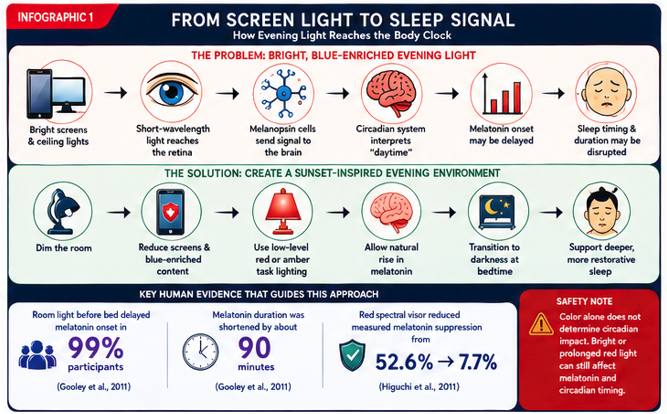
Instead of watching the sky gradually shift from bright blue daylight to orange and red twilight, many people spend the final hours of the day under bright ceiling lights, televisions, tablets, and phones. This creates an environment that can tell the brain it is still daytime—even when bedtime is approaching.
That has led to growing interest in using red-enriched lighting or red light therapy devices in the evening to create a more sunset-like environment.
But does red light actually increase melatonin, improve sleep, or reset the circadian clock?
The evidence is more nuanced than many product claims suggest.
Red light is generally less powerful than blue light at suppressing melatonin, particularly at practical household levels. However, red light is not completely invisible to the circadian system. Bright, prolonged, or intermittent red exposure can suppress melatonin, increase alertness, or shift circadian phase.
The most defensible, objective conclusion we can draw is that a dim, red-enriched evening environment may be a useful replacement for bright, blue-heavy room light and screens. Separate red or near-infrared photobiomodulation sessions may also support sleep in some people, but the direct human evidence is preliminary and device-specific.
Key findings
Evening light intensity matters as much as color.
Ordinary room light before bed can delay melatonin onset and shorten melatonin duration.
Blue and blue-green wavelengths generally have a stronger melatonin-suppressing effect than long-wavelength red light.
High-intensity red light can still suppress melatonin.
Red light can increase alertness without necessarily suppressing melatonin.
A small athlete study found that nightly red-light body irradiation improved sleep scores and serum melatonin.
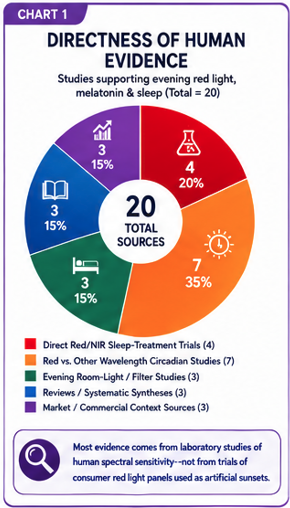
A modern randomized sham-controlled trial has investigated red and near-infrared exposure before bed, but the evidence base remains small.
The strongest evening strategy is to dim the entire environment, reduce screens, and maintain a consistent sleep-wake schedule.
A consumer red light panel should be marketed as an optional wind-down tool—not as a cure for insomnia or circadian rhythm disorders.
What Is Circadian Alignment?
Circadian alignment means that sleep, wakefulness, hormone release, body temperature, appetite, and other biological processes occur at times that match the body’s internal approximately 24-hour clock.
The central circadian clock receives timing information from light entering the eyes. Specialized retinal cells are particularly responsive to short-wavelength blue and blue-green light. That light signal is sent to the brain’s suprachiasmatic nucleus, which helps coordinate melatonin timing and the sleep-wake cycle.
This is why the same light that is useful in the morning can be disruptive late at night.
Morning light can help signal:
wakefulness;
daytime alertness;
an earlier circadian phase; and
a stable sleep-wake schedule.
Bright evening light can signal:
continued daytime;
delayed melatonin onset;
greater alertness; and
later sleep timing.
Why Screens and Bright Room Lights Matter at Night
Screens are not the only source of evening circadian stimulation.
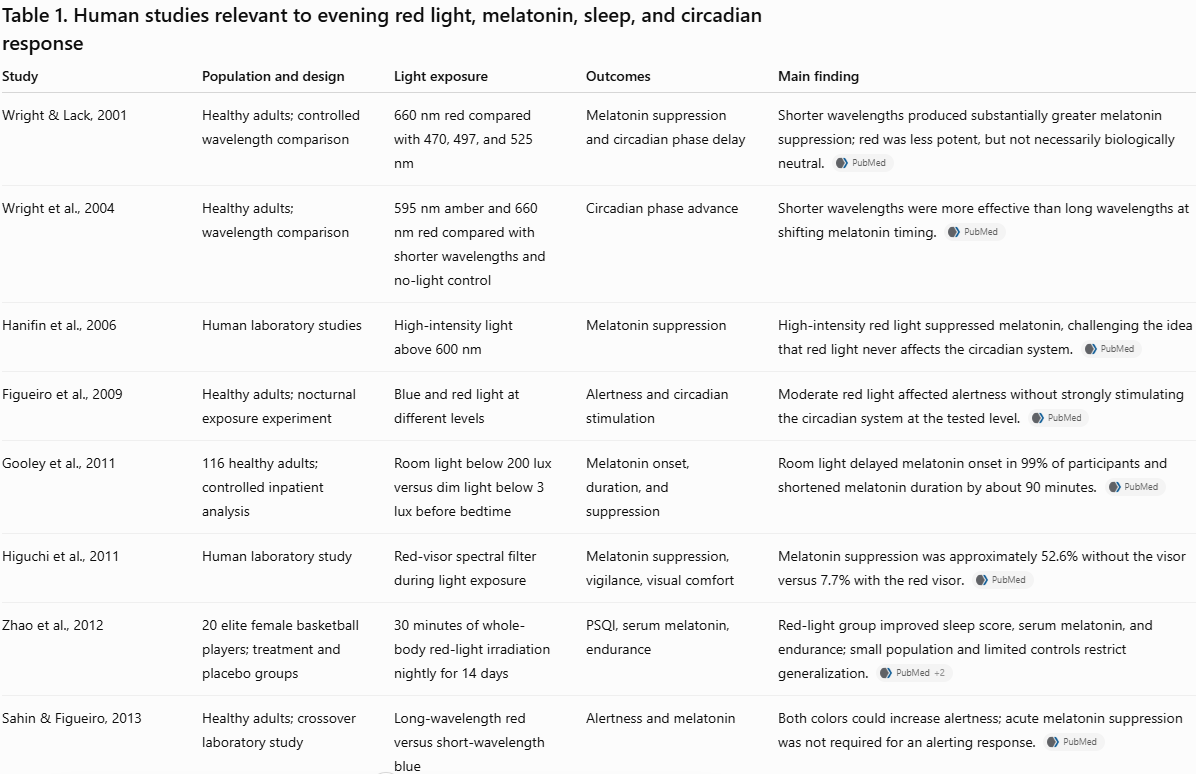
In a controlled study of 116 healthy adults, exposure to ordinary room light below 200 lux during the eight hours before bedtime delayed melatonin onset in 99% of participants and shortened melatonin duration by approximately 90 minutes compared with dim light below 3 lux. Room light during usual sleep hours suppressed melatonin by more than 50% in most trials. [1]
This means that switching a phone to night mode while leaving bright ceiling lights on may not fully solve the problem.
A circadian-supportive evening involves:
lower total illuminance;
less light reaching the eyes;
reduced short-wavelength content;
lower-positioned lighting;
fewer stimulating screens; and
a transition to darkness at bedtime.
Is Red Light Better Than Blue Light Before Bed?
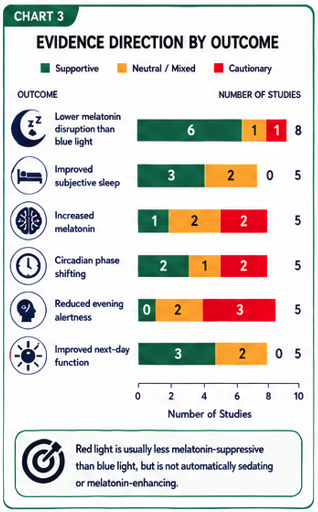
At comparable practical exposure levels, red light is usually less effective than blue light at suppressing melatonin.
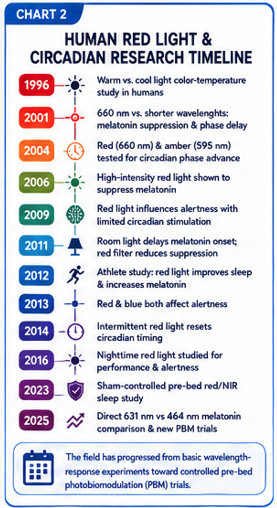
Controlled wavelength experiments show that shorter wavelengths around the blue and blue-green range produce stronger melatonin suppression and phase-shifting effects than longer red wavelengths.
However, the statement “red light does not affect melatonin” is too absolute.
A human study found that high-intensity red light could suppress melatonin. Other experiments have shown that red light can shift circadian phase or increase nighttime alertness under certain conditions.
The More Accurate Rule of Thumb
Dim red-enriched light is generally less circadian-disruptive than bright blue-enriched light—but dose, brightness, duration, timing, and eye exposure still matter.
Does Evening Red Light Increase Melatonin?
The most frequently cited human study involved 20 elite female basketball players.
Ten athletes received 30 minutes of whole-body red-light irradiation each night for 14 days, while ten participants served as controls. The treatment group showed improved Pittsburgh Sleep Quality Index scores, higher serum melatonin, and improved endurance performance.
This study is interesting, but it has important limitations:
only 20 participants;
a specialized athletic population;
a short intervention;
limited control details compared with modern sham-controlled trials;
no proof that the results generalize to people with insomnia; and
no proof that every red light panel or wavelength produces the same effect.
Bottom line: a small human study suggests that nightly red-light exposure may improve sleep quality and melatonin in athletes.
Red and Near-Infrared Photobiomodulation Before Bed
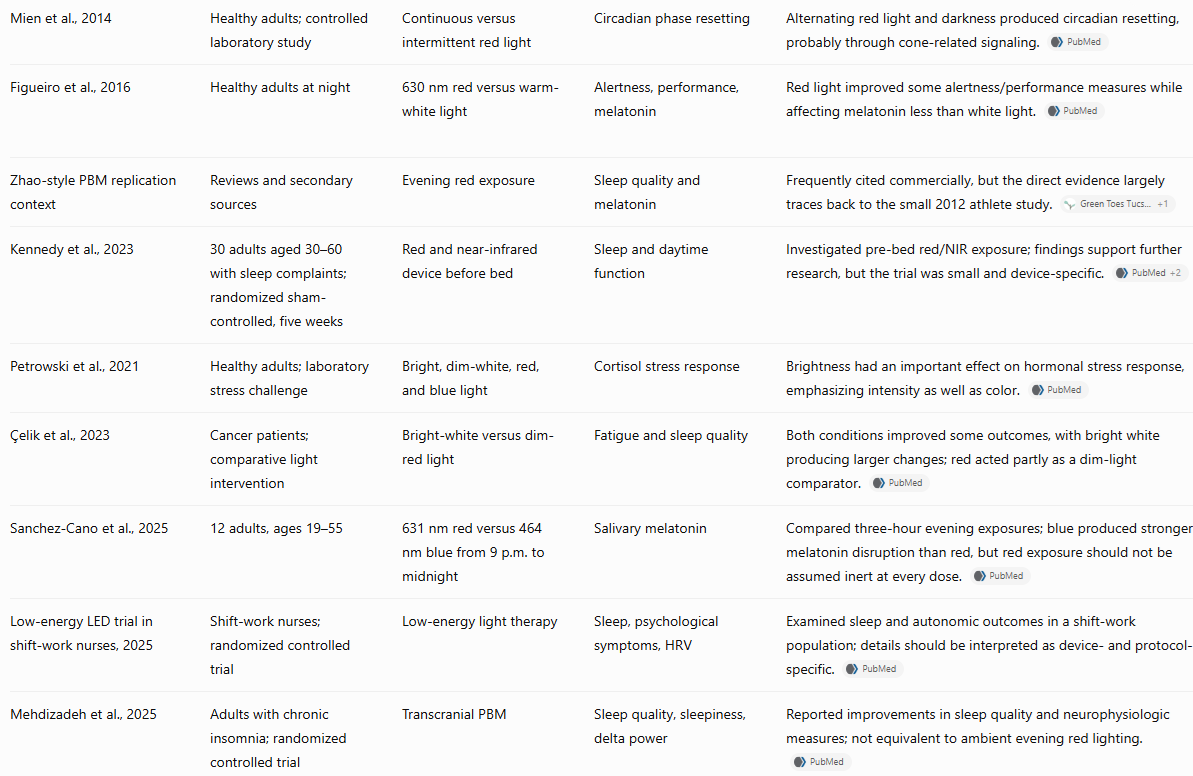
A 2023 randomized, sham-controlled study investigated a red and near-infrared phototherapy device in 30 adults with self-reported sleep complaints over five weeks. The study was designed to measure sleep and next-day function.
This is an important step toward stronger evidence because it included a sham comparison. However, it remains a small, device-specific trial.
Other recent PBM research has examined low-energy LED exposure in shift workers and transcranial photobiomodulation in chronic insomnia. These interventions may affect sleep through mechanisms other than sunset-like ocular light signaling, including mitochondrial metabolism, neural activity, pain, autonomic regulation, or relaxation.
That distinction matters:
Ambient red lighting primarily changes the visual and circadian environment.
Body PBM delivers a tissue dose.
Transcranial PBM is a specialized neuromodulation intervention.
What About Alertness?
A common assumption is that red light must be sedating because it suppresses melatonin less than blue light. Human research does not support that assumption.
Several studies found that long-wavelength red light could increase alertness or nighttime performance without producing the same degree of melatonin suppression as white or blue light.
This may be useful for:
overnight workers;
aviation or transportation settings;
control rooms; and
situations requiring alertness with reduced circadian disruption.
It is less useful for someone trying to become sleepy.
For a bedtime routine, the practical objective should therefore be:
low brightness;
low visual stimulation;
limited duration;
relaxation; and
transition to darkness.
Does Red Light Mimic Sunset?
Red-enriched light resembles one spectral feature of sunset: a greater relative proportion of long-wavelength visible light.
But a red LED panel does not reproduce a sunset automatically.
Natural sunset also involves:
a major reduction in illuminance;
gradual spectral change;
light coming from the horizon rather than overhead;
reduced ultraviolet and blue content;
changing environmental temperature;
behavioral transition; and
eventual darkness.
A bright red panel used close to the face can deliver far more red irradiance than natural twilight.
The best sunset-inspired routine therefore combines lower brightness, warmer or red-enriched lighting, less screen exposure, and darkness at bedtime.
An Evidence-Informed Evening Red-Light Routine
Two hours before bed
Dim overhead lighting and use lower-positioned lamps. Choose warm, amber, or dim red-enriched lighting for tasks.
One hour before bed
Reduce screen use. When screens are necessary:
lower brightness;
use night-shift settings;
increase viewing distance;
avoid holding the display close to the eyes; and
choose calm rather than highly stimulating content.
Twenty to thirty minutes before bed
An optional red/NIR panel session can become a consistent wind-down cue.
A practical routine might include:
10–20 minutes;
comfortable treatment distance;
eyes closed or protected when directed;
no staring into LEDs;
other lights dimmed; and
quiet reading, breathing, or stretching.
The 10–20-minute window is a consumer routine, not a universally established sleep-treatment dose. Follow the device’s instructions.
At bedtime
Turn the panel and other lights off. Sleep in a dark room.
The following morning
Get outdoor daylight soon after waking. A stable morning-light signal is often more important for circadian alignment than any evening device.
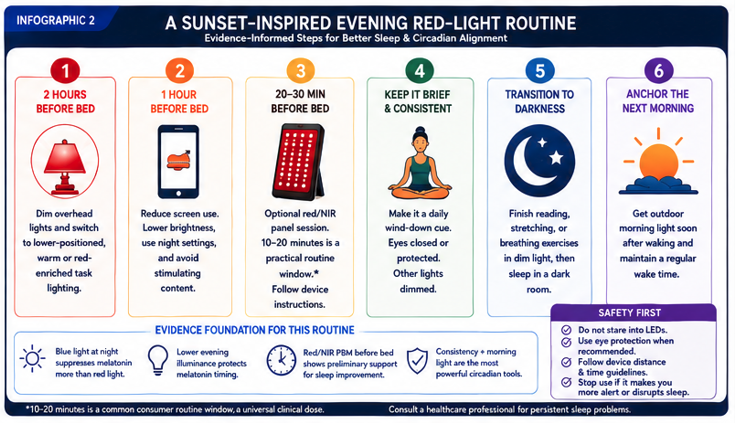
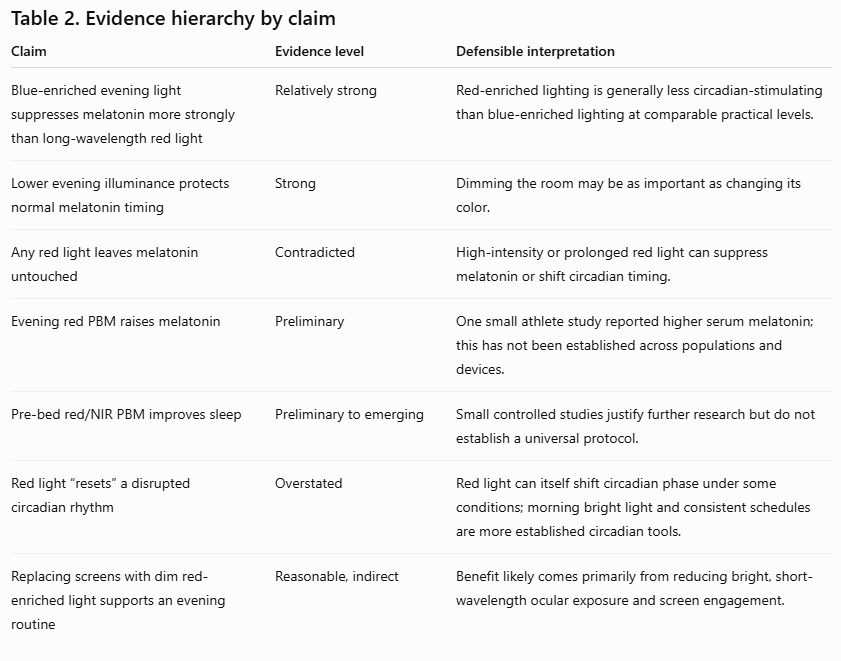
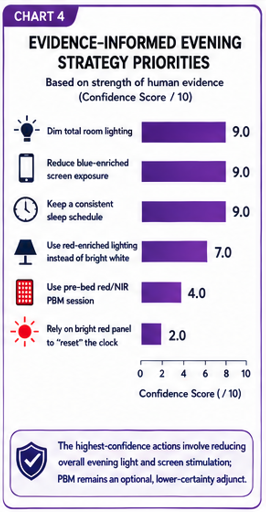
Chart 4 highlights a central conclusion:
Red-light devices should complement—not replace—basic circadian hygiene.
The most established actions remain:
dimming the evening environment;
reducing bright screens;
waking at a consistent time;
obtaining morning daylight;
sleeping in darkness; and
managing caffeine, exercise, and meal timing.
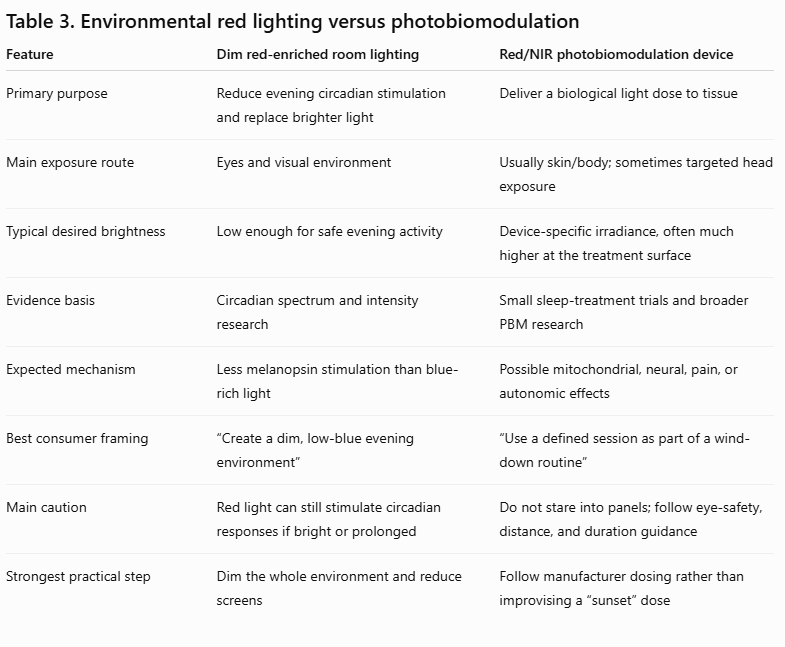
Red Light Panels Versus Red Bedside Lamps
Red-enriched bedside lamp
Best suited to:
reading;
bathroom trips;
general evening illumination; and
replacing brighter white lamps.
Important specification:
low illuminance at eye level;
minimal blue leakage;
comfortable dimming;
no flicker; and
appropriate brightness for safe movement.
Red light therapy panel
Best suited to:
a timed body treatment;
skin or recovery routines;
a structured evening ritual; and
delivering specified red/NIR wavelengths.
Important specification:
disclosed wavelengths;
irradiance and distance guidance;
timer;
independent red/NIR controls when available;
low flicker;
eye-safety instructions; and
reliable warranty and support.
A therapy panel should not be left on as a bright room light throughout the night.
Market Context: Why Evening Light Devices Are Growing
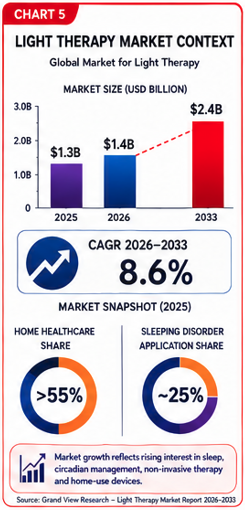
Grand View Research estimated the global light therapy market at $1.3 billion in 2025 and projected growth to $2.4 billion by 2033, with an estimated compound annual growth rate of 8.6% from 2026 through 2033.
The report associates growth with increasing consumer interest in sleep disorders, circadian rhythm management, non-invasive therapy, and home-use devices. It reports that home healthcare represented more than 55% of the market in 2025 and that sleeping disorders represented approximately 25% of application revenue. [4]
These figures demonstrate commercial interest. They do not independently prove clinical effectiveness.
Evening Red Light & Circadian Rhythm
Green Toes presents evening red light as a way to replace blue-heavy screens, create a calmer environment, and establish a 20–30-minute pre-bed routine. Those suggestions are broadly consistent with reducing evening light stimulation, but claims that red light increases serotonin, lowers cortisol, or reliably resets the circadian rhythm go beyond the direct evidence cited on the page. [5]
The Rojo Light Therapy article promotes timing red light sessions according to personal goals. That is useful as a consumer-routine perspective, but manufacturer content should not be treated as equivalent to randomized clinical evidence.
Use these pages for:
consumer questions;
routine ideas;
objections and FAQs; and
market language.
As a consumer, you should not use red light panels as the principal support for medical or hormonal cures.
Can Red Light Therapy Treat Insomnia?
There is not yet enough evidence to present a general consumer panel as an established treatment for chronic insomnia.
A person should speak with a healthcare professional when sleep problems:
occur at least three nights per week;
persist for several months;
impair daytime function;
involve loud snoring, choking, or breathing pauses;
occur with restless legs;
involve extreme sleepiness;
follow a major mood change; or
continue despite good sleep habits.
Cognitive behavioral therapy for insomnia remains a well-established first-line treatment for chronic insomnia.
Safety Considerations
Red and near-infrared devices are bright.
Follow these precautions:
Do not stare directly into LEDs.
Use supplied eye protection when instructed.
Do not assume that red light cannot affect the circadian system.
Avoid excessively bright treatment immediately before bed if it makes you more alert.
Follow the device’s distance and time recommendations.
Speak with a clinician when taking photosensitizing medication or managing a medical sleep disorder.
Stop or adjust evening use if sleep latency, headaches, eye discomfort, or nighttime alertness worsens.
How to Choose a Red Light Panel for an Evening Routine
Independent wavelength controls
The ability to use red light without near-infrared may be useful for customers who prefer visible evening sessions, while separate controls increase versatility.
Timer and dimming
A built-in timer makes a consistent 10–20-minute routine easier. Dimming is especially useful for evening visual comfort.
Transparent output data
The manufacturer should disclose:
wavelength peaks;
irradiance by distance;
beam angle;
flicker measurements;
session guidance; and
eye-safety recommendations.
Low flicker and quiet cooling
A relaxing device should not introduce visible flicker or excessive fan noise.
Coverage that matches the routine
A tabletop or compact panel may be sufficient for a seated evening ritual. A larger panel is more appropriate for whole-body skin and recovery goals.
Build a Better Evening Routine
A red light panel can become a practical cue to stop scrolling, lower the lights, and begin winding down.
The strongest routine combines the device with:
a consistent bedtime;
reduced screen exposure;
low evening illuminance;
a dark bedroom;
morning outdoor light;
regular exercise; and
appropriate medical care for persistent sleep problems.
Shop Red Light Therapy Panels
Frequently Asked Questions
Does red light increase melatonin?
One small athlete study reported increased serum melatonin after 14 nights of red-light treatment. This result has not been established across populations and devices.
Is red light better than blue light before bed?
At practical exposure levels, red light generally has less melatonin-suppressing power than blue light. Bright red light can still affect melatonin and circadian timing.
When should I use red light therapy for sleep?
A practical routine is 10–20 minutes during the final 20–30 minutes before bed, provided the device instructions permit it and the session feels relaxing rather than alerting.
Should I leave a red light on all night?
No. A dark sleeping environment is generally preferable. Use dim red lighting briefly when nighttime visibility is necessary.
Does a red light panel mimic sunset?
Only partially. Sunset includes declining brightness, gradual spectral change, horizon-positioned light, and eventual darkness. A bright panel does not recreate all of those conditions.
Can red light reset my circadian rhythm?
Red light can influence circadian phase under some laboratory conditions, but it is not an established universal method for correcting a circadian rhythm disorder. Morning light and consistent timing are generally more established.
Is near-infrared light the same as red room lighting?
No. Near-infrared light is invisible and is generally used for photobiomodulation. Red room lighting changes the visual environment and ocular spectral exposure.
For Additional Reading:
Check out our most popular blogs on red light therapy to save you time and money on your next purchase with Medford Red Light Therapy:
Scientific References
Gooley JJ, Chamberlain K, Smith KA, et al. Exposure to room light before bedtime suppresses melatonin onset and shortens melatonin duration in humans. J Clin Endocrinol Metab. 2011;96(3)–E472. doi:10.1210/jc.2010-2098.
Zhao J, Tian Y, Nie J, Xu J, Liu D. Red light and the sleep quality and endurance performance of Chinese female basketball players. J Athl Train. 2012;47(6):673–678. doi:10.4085/1062-6050-47.6.08.
Kennedy KER, Wills CC, Holt C, et al. A randomized, sham-controlled trial of a novel near-infrared phototherapy device on sleep and daytime function. J Clin Sleep Med. 2023;19(9):1669–1675. doi:10.5664/jcsm.10648.
Wright HR, Lack LC. Effect of light wavelength on suppression and phase delay of the melatonin rhythm. Chronobiol Int. 2001.
Wright HR, Lack LC, Kennaway DJ. Differential effects of light wavelength in phase advancing the melatonin rhythm. J Pineal Res. 2004.
Hanifin JP, Stewart KT, Smith P, Tanner R, Rollag M, Brainard GC. High-intensity red light suppresses melatonin. Chronobiol Int. 2006;23:251–268.
Figueiro MG, Bierman A, Plitnick B, Rea MS. Preliminary evidence that both blue and red light can induce alertness at night. BMC Neurosci. 2009.
Higuchi S, Fukuda T, Kozaki T, Takahashi M, Miura N. Effectiveness of a red-visor cap for preventing light-induced melatonin suppression during simulated night work. 2011.
Sahin L, Figueiro MG. Alerting effects of short-wavelength blue and long-wavelength red lights in the afternoon. Physiol Behav. 2013.
Mien IH, Chua EC, Lau P, et al. Effects of exposure to intermittent versus continuous red light on human circadian rhythms. 2014.
Figueiro MG, Sahin L, Wood B, Plitnick B. Light at night and measures of alertness and performance. Biol Res Nurs. 2016.
Cho CH, Lee HJ, Yoon HK, et al. Exposure to dim artificial light at night increases REM sleep and awakenings in humans. [Include after final bibliographic verification.]
Sanchez-Cano A, et al. Comparative effects of red and blue LED light on melatonin secretion. Clocks & Sleep. 2025.
Mehdizadeh M, Farnam A, Nikzad B. Transcranial photobiomodulation improves sleep quality, reduces daytime sleepiness, and modulates delta power in chronic insomnia: a randomized controlled trial. Lasers Med Sci. 2025.
Dacey DM, Liao HW, Peterson BB, Robinson FR, Smith VC, et al. (2005) Melanopsin-expressing ganglion cells in primate retina signal colour and irradiance and project to the LGN. Nature 433: 749–754.
Dkhissi-Benyahya O, Gronfier C, De Vanssay W, Flamant F, Cooper HM (2007) Modeling the role of mid-wavelength cones in circadian responses to light. Neuron 53: 677–687.
Panda S, Sato TK, Castrucci AM, Rollag MD, Degrip WJ, et al. (2002) Melanopsin (Opn4) requirement for normal light-induced circadian phase shifting. Science 298: 2213–2215.
Ruby NF, Brennan TJ, Xie X, Cao V, Franken P, et al. (2002) Role of melanopsin in circadian responses to light. Science 298: 2211–2213.
Lall GS, Revell VL, Momiji H, Al EJ, Altimus CM, et al. (2010) Distinct contributions of rod, cone, and melanopsin photoreceptors to encoding irradiance. Neuron 66: 417–428.
Gooley JJ, Rajaratnam SM, Brainard GC, Kronauer RE, Czeisler CA, et al. (2010) Spectral responses of the human circadian system depend on the irradiance and duration of exposure to light. Sci Transl Med 2: 31ra33.
Mure LS, Cornut PL, Rieux C, Drouyer E, Denis P, et al. (2009) Melanopsin bistability: a fly's eye technology in the human retina. PLoS One 4: e5991. Gooley JJ, Ho Mien I, St Hilaire MA, Yeo SC, Chua EC, et al. (2012) Melanopsin and rod-cone photoreceptors play different roles in mediating pupillary light responses during exposure to continuous light in humans. J Neurosci 32: 14242–14253.
Zaidi FH, Hull JT, Peirson SN, Wulff K, Aeschbach D, et al. (2007) Short-wavelength light sensitivity of circadian, pupillary, and visual awareness in humans lacking an outer retina. Curr Biol 17: 2122–2128.
Wong KY, Dunn FA, Graham DM, Berson DM (2007) Synaptic influences on rat ganglion-cell photoreceptors. J Physiol 582: 279–296.
Mrosovsky N, Hattar S (2005) Diurnal mice (Mus musculus) and other examples of temporal niche switching. J Comp Physiol A Neuroethol Sens Neural Behav Physiol 191: 1011–1024. -
Chua EC, Tan WQ, Yeo SC, Lau P, Lee I, et al. (2012) Heart rate variability can be used to estimate sleepiness-related decrements in psychomotor vigilance during total sleep deprivation. Sleep 35: 325–334.
Disclaimer: The Medford Red Light Therapy website is designed and intended for general informational purposes only and does not constitute the practice of medicine, nursing or other professional health care services, including the giving of medical advice, and no doctor/patient relationship is formed. The use of information on this website is at the user’s own risk. Results may vary by individual. The content of this website is not intended to be a substitute for professional medical advice, diagnosis, or treatment. Users should not disregard or delay in obtaining medical advice for any medical condition they may have and should seek the assistance of their health care professionals for any such conditions.
